This edition‚ extensively reviewed‚ remains a valuable‚ long-term reference due to the enduring nature of core technologies within electric power systems.
Overview of the Textbook
This textbook provides a comprehensive exploration of electric power systems‚ meticulously crafted for both students and practicing engineers. It delves into fundamental concepts‚ advanced analysis techniques‚ and practical applications crucial for understanding modern power systems. The 5th edition builds upon established foundations‚ incorporating recent advancements and addressing evolving industry challenges.
Throughout the chapters‚ a wealth of worked-out problems and end-of-chapter exercises – categorized by practical‚ intermediate‚ and advanced levels – facilitate deeper comprehension and skill development. A dedicated Solutions Manual supports instructors‚ enhancing the teaching and learning experience. The book’s structure allows for effective self-study‚ making it ideal for continuing education and professional development. It’s designed to be a lasting resource‚ applicable to the real-world electrical industry.
Target Audience and Applications
This textbook is primarily aimed at senior undergraduate and graduate students pursuing degrees in electrical engineering‚ specifically those specializing in power systems analysis and design. It also serves as an invaluable resource for practicing engineers involved in the operation‚ planning‚ and maintenance of electric power networks.
Instructors utilizing this book will find ample practical information suitable for industrial training programs‚ directly applicable to real-world scenarios within the electrical industry. The content supports self-study initiatives‚ benefiting professionals engaged in continuing education. Applications span a broad spectrum‚ including power generation‚ transmission‚ distribution‚ and protection‚ equipping readers with the knowledge to tackle complex challenges in the field.
Fundamentals of Electrical Power Systems
Core concepts like voltage‚ current‚ and power are foundational‚ alongside AC circuit analysis and the intricacies of three-phase systems‚ forming the base.
Basic Concepts: Voltage‚ Current‚ and Power
Understanding the fundamental relationship between voltage‚ current‚ and power is paramount in grasping electrical power systems. Voltage‚ representing the electrical potential difference‚ drives the flow of current through a circuit. Current‚ the rate of electric charge flow‚ is directly proportional to voltage‚ governed by Ohm’s Law. Power‚ the rate at which energy is transferred‚ is the product of voltage and current.
These concepts are not merely theoretical; they are the building blocks for analyzing and designing all components within a power system. Instructors will find this section invaluable for industrial training‚ providing a practical foundation for students entering the electrical industry. The book’s worked-out problems and end-of-chapter exercises‚ categorized by difficulty‚ further reinforce these core principles‚ making it ideal for self-study and continuous education.
Furthermore‚ a solid grasp of these basics is essential for tackling more advanced topics‚ such as load flow studies and fault analysis‚ ensuring a comprehensive understanding of power system operation.
AC Circuit Analysis
Alternating Current (AC) circuit analysis forms a crucial cornerstone of electric power systems‚ differing significantly from direct current (DC) circuits due to the time-varying nature of voltage and current. Key concepts include impedance‚ which combines resistance and reactance‚ and phasor diagrams‚ used to represent sinusoidal quantities. Analyzing AC circuits involves techniques like Kirchhoff’s laws adapted for sinusoidal waveforms and the application of complex number arithmetic.
This book provides a detailed exploration of these techniques‚ offering numerous worked-out examples to illustrate practical applications. The material is presented with a focus on its relevance to industrial training‚ equipping students with the skills needed for real-world scenarios. The end-of-chapter problems‚ ranging from practical to advanced‚ encourage problem-solving and reinforce understanding.
Moreover‚ mastering AC circuit analysis is fundamental for comprehending power factor correction and harmonic mitigation‚ vital aspects of efficient power system operation.
Three-Phase Systems
Electric power systems overwhelmingly utilize three-phase systems for generation‚ transmission‚ and distribution due to their efficiency and ability to deliver constant power. This section delves into the intricacies of three-phase circuits‚ exploring concepts like balanced and unbalanced loads‚ phase sequences‚ and power calculations in three-phase configurations.
The textbook provides a comprehensive treatment of delta and wye connections‚ including their voltage and current relationships. Emphasis is placed on understanding the advantages of three-phase power‚ such as reduced conductor material and smoother motor operation. Numerous examples demonstrate practical applications in industrial settings.
Furthermore‚ the material prepares readers for analyzing more complex power system components and phenomena‚ building a solid foundation for advanced topics like fault analysis and power flow studies.
Power System Components
This section meticulously examines essential elements – transformers‚ circuit breakers‚ and conductors – detailing their characteristics‚ operation‚ selection‚ and crucial properties within power systems.
Transformers: Characteristics and Operation
Transformers are indispensable components within electric power systems‚ facilitating efficient voltage transformation for transmission and distribution. Their operation hinges on the principle of electromagnetic induction‚ enabling energy transfer between circuits with differing voltage levels. Key characteristics include the turns ratio‚ which dictates the voltage transformation ratio‚ and impedance‚ influencing voltage regulation and short-circuit performance.
Core construction – employing laminated steel to minimize eddy current losses – is crucial for transformer efficiency. Understanding transformer parameters like magnetizing current‚ core loss‚ and copper loss is vital for performance analysis. Furthermore‚ the book delves into transformer connections (delta-wye‚ wye-delta‚ etc.)‚ impacting phase shifts and harmonic behavior. Practical applications‚ including step-up and step-down transformers in transmission networks and distribution substations‚ are thoroughly explored‚ alongside considerations for transformer cooling and protection.
Circuit Breakers: Types and Applications
Circuit breakers are critical protective devices in electric power systems‚ designed to interrupt fault currents and safeguard equipment. The text comprehensively covers various types‚ including oil circuit breakers‚ air blast circuit breakers‚ and modern SF6 circuit breakers‚ detailing their operating principles and characteristics. Each type’s arc interruption method‚ speed of operation‚ and maintenance requirements are analyzed.
Applications span across transmission substations‚ distribution networks‚ and industrial facilities. The book explores selection criteria based on voltage level‚ fault current magnitude‚ and system requirements. Furthermore‚ it discusses coordination with other protective devices‚ like relays‚ to ensure selective tripping and minimize system outages. Understanding breaker ratings‚ interrupting capacity‚ and reclosing schemes is essential for reliable power system operation and protection against damaging faults.
Conductors and Cables: Selection and Properties
Conductors and cables form the physical pathways for electrical energy delivery‚ demanding careful selection based on numerous factors. The text details the properties of common conductor materials – copper and aluminum – including their conductivity‚ tensile strength‚ and cost considerations. Cable insulation materials‚ such as XLPE and PVC‚ are also examined‚ focusing on their dielectric strength and temperature ratings.
Selection criteria encompass current-carrying capacity‚ voltage drop‚ and environmental conditions. The book explores methods for calculating conductor size to minimize losses and maintain acceptable voltage levels. Furthermore‚ it addresses the impact of skin effect and proximity effect on AC resistance. Understanding cable parameters‚ like capacitance and inductance‚ is crucial for accurate power system modeling and analysis‚ ensuring efficient and reliable power transmission.

Power System Analysis
Analysis techniques‚ including load flow studies utilizing the Gauss-Seidel method‚ and fault analysis determining fault current and levels‚ are thoroughly explored.
Load Flow Studies: Gauss-Seidel Method
Load flow studies are fundamental to power system analysis‚ determining voltage magnitudes and angles at each bus within the network under specified load conditions. The Gauss-Seidel method‚ an iterative technique‚ provides a straightforward approach to solving these complex equations. This method sequentially updates bus voltages based on power balance equations‚ continuing iterations until a satisfactory level of convergence is achieved.
The process involves formulating a set of non-linear algebraic equations representing power flow constraints. Initial voltage estimates are crucial‚ and the iterative process refines these values. While relatively simple to implement‚ the Gauss-Seidel method’s convergence speed can be slow for larger systems‚ and its success depends heavily on the network topology and initial voltage assumptions. Despite these limitations‚ it remains a valuable tool for understanding basic load flow principles and serves as a foundation for more advanced techniques.
Fault Analysis: Fault Current and Fault Level
Fault analysis is critical for ensuring power system safety and reliability‚ focusing on determining the magnitude of fault current and establishing the fault level. These calculations are essential for selecting appropriate protective devices‚ like circuit breakers‚ capable of interrupting these potentially damaging currents. Different fault types – three-phase‚ line-to-ground‚ line-to-line – each produce unique current characteristics.
Accurate fault current calculations require detailed network modeling‚ including impedance data for all system components. The fault level‚ often expressed in MVA‚ represents the maximum apparent power that can flow during a fault. Understanding these values allows engineers to design protective schemes that isolate faults quickly and minimize system disturbances. Proper fault analysis is paramount for preventing equipment damage and maintaining power supply continuity.
Short-Circuit Calculations
Short-circuit calculations are fundamental to power system design and protection‚ determining the prospective current during fault conditions. These calculations utilize network parameters – impedances of overhead lines‚ transformers‚ and other components – to model fault scenarios. Methods like symmetrical component analysis are employed to analyze unbalanced faults‚ such as line-to-ground faults.
The results of these calculations dictate the interrupting capacity required for circuit breakers and other protective devices. Accurate short-circuit calculations are vital for ensuring selective coordination‚ where only the faulted section is isolated‚ minimizing disruption to the rest of the system. Factors like line parameters (capacitance and losses) and source impedance significantly influence fault current magnitudes‚ demanding precise modeling for reliable results.

Transmission and Distribution Systems

Electric energy delivery relies on overhead lines and distribution systems‚ carefully designed considering line parameters‚ losses‚ and configurations for optimal performance.
Overhead Lines: Characteristics and Design
Overhead lines form a crucial component of transmission systems‚ demanding careful consideration of numerous characteristics during their design and implementation. The line diagram is essential for visualizing the system. Key factors include determining the appropriate line voltage and ensuring adequate insulation to prevent flashover phenomena.
Line parameters‚ such as capacitance and resistance‚ significantly impact performance and must be accurately calculated. Understanding the effect of these parameters on losses and voltage drop is paramount. The cost of materials and construction plays a vital role‚ alongside considerations for the surrounding earth and environmental impact.
Designers must also account for potential fault current levels and select appropriate circuit breaker protection schemes. The frequency of operation and the magnitude of potential disturbances are critical design considerations‚ ensuring reliable and safe power delivery. Proper conductor selection is also vital.
Line Parameters: Capacitance and Losses
Line parameters profoundly influence electric power systems performance‚ with capacitance and losses being particularly significant. Capacitance arises from the electric field between conductors and ground‚ impacting voltage levels and power factor. Accurate capacitance calculation is essential for stability studies.
Losses in overhead lines stem from conductor resistance‚ leading to I2R losses‚ and corona discharge‚ especially at higher voltages. Minimizing these losses is crucial for efficient power transfer. The effect of these parameters is intertwined with the line’s configuration and conductor spacing.
Understanding how these parameters change with frequency and load is vital. Determining the equivalent circuit helps model these effects. Furthermore‚ the angle of the voltage and current impacts the overall power flow and associated losses‚ requiring careful analysis during system design.
Distribution Systems: Configurations and Considerations
Distribution systems represent the final stage of power delivery‚ connecting bulk transmission networks to individual consumers. Common configurations include radial‚ loop‚ and networked systems‚ each offering trade-offs in reliability and cost. Line voltage regulation and minimizing losses are primary design considerations.
Distribution planning must account for load density‚ future growth‚ and the integration of distributed generation sources. The selection of conductors and cable types impacts system performance and cost. Fault current levels and protection schemes are critical for safety and service continuity.
Furthermore‚ the earth’s influence and insulation coordination are vital for reliable operation. Analyzing the frequency of disturbances and implementing appropriate mitigation strategies are essential for maintaining power quality and ensuring a stable distribution network.
Power System Protection
Power system protection focuses on mitigating harmonics‚ ensuring proper insulation coordination‚ and understanding flashover phenomena for reliable and safe operation.
Harmonics and Their Mitigation
Harmonics‚ distortions of the sinusoidal waveform‚ significantly impact electric power systems‚ leading to increased losses‚ equipment overheating‚ and malfunctions. These distortions arise from nonlinear loads like power electronic devices and certain industrial equipment. Understanding their frequency and magnitude is crucial for effective mitigation. Several techniques are employed to reduce harmonic distortion‚ including the use of harmonic filters – tuned circuits designed to shunt harmonic currents – and employing harmonic traps.
Active power filters‚ utilizing power electronic converters‚ offer a dynamic and adaptable solution. Proper transformer connections‚ such as delta-wye‚ can also help trap certain harmonic orders. Careful system design and load balancing are preventative measures. Analyzing harmonic content requires specialized instruments and software‚ ensuring compliance with IEEE standards like 519‚ which sets limits for harmonic distortion levels. Mitigation strategies must be tailored to the specific harmonic profile of the system.
Insulation Coordination
Insulation coordination is a critical aspect of electric power system design‚ focused on ensuring reliable operation despite transient overvoltages. These overvoltages‚ stemming from switching surges‚ lightning strikes‚ or faults‚ stress the insulation of equipment. The goal is to select insulation levels that withstand these stresses or provide protective devices to limit their impact. Key components include insulation strength‚ protective devices like surge arresters‚ and the coordination between them.
A well-coordinated system minimizes the risk of flashover‚ preventing equipment damage and service interruptions. The Basic Insulation Level (BIL) defines the minimum withstand voltage. Surge arresters divert excess voltage to ground‚ protecting sensitive equipment. Proper coordination involves selecting arrester voltage ratings and placement to effectively clamp overvoltages without nuisance tripping. This process balances cost‚ reliability‚ and performance‚ ensuring a robust and resilient power system.
Flashover Phenomena
Flashover represents a disruptive discharge across the surface of an insulator‚ often occurring under high-voltage stress. This phenomenon is a significant concern in electric power systems‚ potentially leading to short circuits and service outages. Several factors contribute to flashover‚ including voltage levels‚ insulator contamination (dust‚ salt‚ pollution)‚ atmospheric conditions (humidity‚ rain)‚ and the presence of defects. Understanding these factors is crucial for effective system design and maintenance.
The insulating medium’s breakdown strength is reduced by contamination‚ lowering the flashover voltage. Proper insulator cleaning and the application of protective coatings mitigate this effect. Flashover can occur along insulators on overhead lines‚ within switchgear‚ or across the surfaces of transformers. Insulation coordination strategies‚ including surge arresters‚ are employed to prevent flashover or limit its consequences‚ ensuring system reliability and safety.
Advanced Topics

Exploration delves into interconnected systems‚ induction motor operation‚ and per-unit values‚ offering a deeper understanding of complex electric power systems analysis.
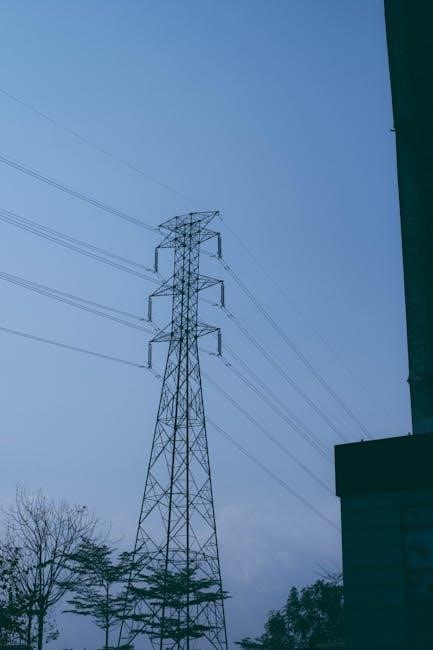
Interconnected Power Systems and Infinite Busbar
The analysis of interconnected power systems is crucial for understanding large-scale grid behavior‚ especially concerning stability and reliability. These systems‚ comprising multiple generating stations and transmission networks‚ demand sophisticated modeling techniques to accurately predict their response to disturbances. A key simplification used in such analysis is the concept of the infinite busbar – a hypothetical source of constant voltage and frequency‚ regardless of the connected load or generation changes.
This idealization allows for focused study of specific system components without the complexities of modeling the entire network. The infinite busbar assumption is particularly useful in initial stability studies‚ providing a benchmark for assessing the impact of faults or generator outages. Understanding the behavior of systems connected to an infinite busbar is fundamental to designing robust control strategies and ensuring the secure operation of modern power grids. It’s a cornerstone of advanced power system analysis.
Induction Motor Operation in Power Systems
Induction motors represent the dominant load in most power systems‚ accounting for a substantial portion of total electricity consumption. Their widespread use necessitates a thorough understanding of their operational characteristics and impact on grid stability. These motors draw reactive power to establish the magnetic field required for operation‚ contributing to voltage drops and potentially impacting power factor.
Analyzing induction motor behavior during system disturbances‚ such as voltage sags or faults‚ is critical for assessing their ability to remain connected and contribute to grid resilience. Factors like rotor inertia and starting current significantly influence system response. Furthermore‚ understanding the interaction between induction motors and power system protection schemes is essential for preventing unwanted tripping and maintaining reliable operation. Their performance is a key consideration.
p.u. Values and Base MVA
Per-unit (p.u.) values and the Base MVA are fundamental tools in power system analysis‚ simplifying calculations and providing a standardized framework for comparing system components. Expressing quantities in per-unit form eliminates the need to deal with large numerical values and facilitates the identification of dominant system parameters. The Base MVA establishes the reference power level for normalization‚ influencing the magnitude of p.u. values.
Choosing an appropriate Base MVA is crucial for accurate analysis; it should reflect the typical operating conditions of the system under study. Utilizing p.u. values streamlines calculations in load flow studies‚ fault analysis‚ and short-circuit calculations‚ enhancing efficiency and clarity. This method allows engineers to focus on relative magnitudes rather than absolute values‚ improving insight.